

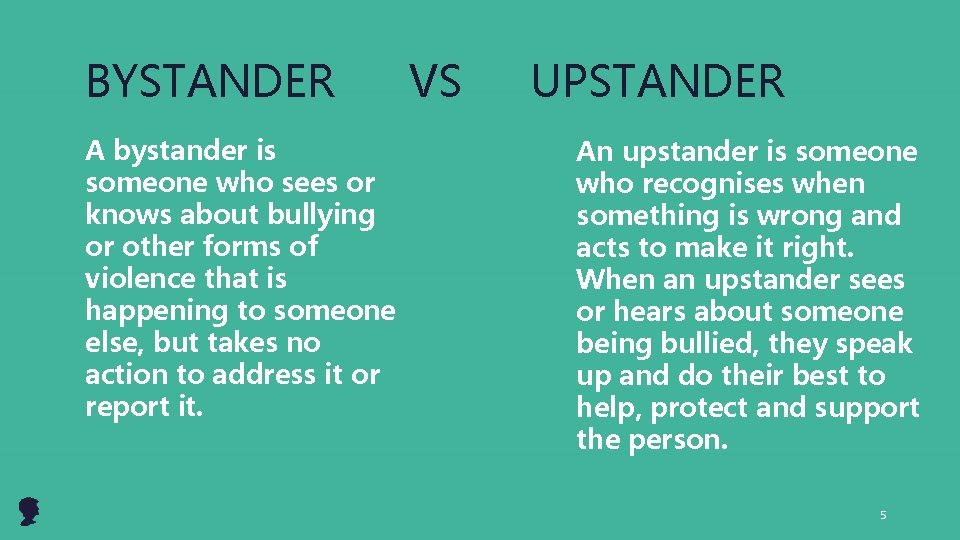
Upstanders: People who act to stop violence
The Up4Diversity approach to ending violence against LGBTIQ+ youth consists in the international evidence-based bystander intervention: the idea that people who witness or are aware of risky or violent situations decide to stand up and act in defence of the victim.
What can upstanders do to be successful? It Is important to know that there are many possible actions, and that the focus should always be first on creating safer environments, either by protecting victims or by explicating the zero-tolerance to violence mindset.
When violence has already happened or is happening, upstanders can:
- Make themselves present to discourage the situation to go on
- Distract the aggressor by asking something, to break the situation
- Delegate or ask for more people to act (either a superior in charge or peers)
- Help report the situation suffered, if the victims wishes to
To prevent violence from happening, upstanders can:
- Raise awareness to their peers by training and dialogue
- Stop hanging out with mean people
- Show themselves available, by stating publicly, with t-shirts or badges that you people can count on you because you will not tolerate any violence to anyone
- Encourage their institution to develop norms agreed by the whole community that do not tolerate violence
Imagine the space of your educational institution and its surroundings. Imagine that for every violent or unpleasant power-based interaction there is a red dot. Imagine now that for every upstander action there is a green dot. How does your institution look like? Ideally, we want to have at least as much green dots as red dots, and ultimately, we wish for red dots to disappear.
In order to do that, let's go one step further: imagine a community where most of its bystanders decide to stand up in different ways to prevent and react violence of any kind, creating upstander networks of solidary and brave people. These are communities (high-schools, colleges, NGOs...) where violent or risky behaviours are much less likely to occur, and when they occur they are faster and more successfully solved.
The Dialogic Model of Conflict Prevention and Resolution applies bystander intervention as a community strategy. But more on this model on a future blog


